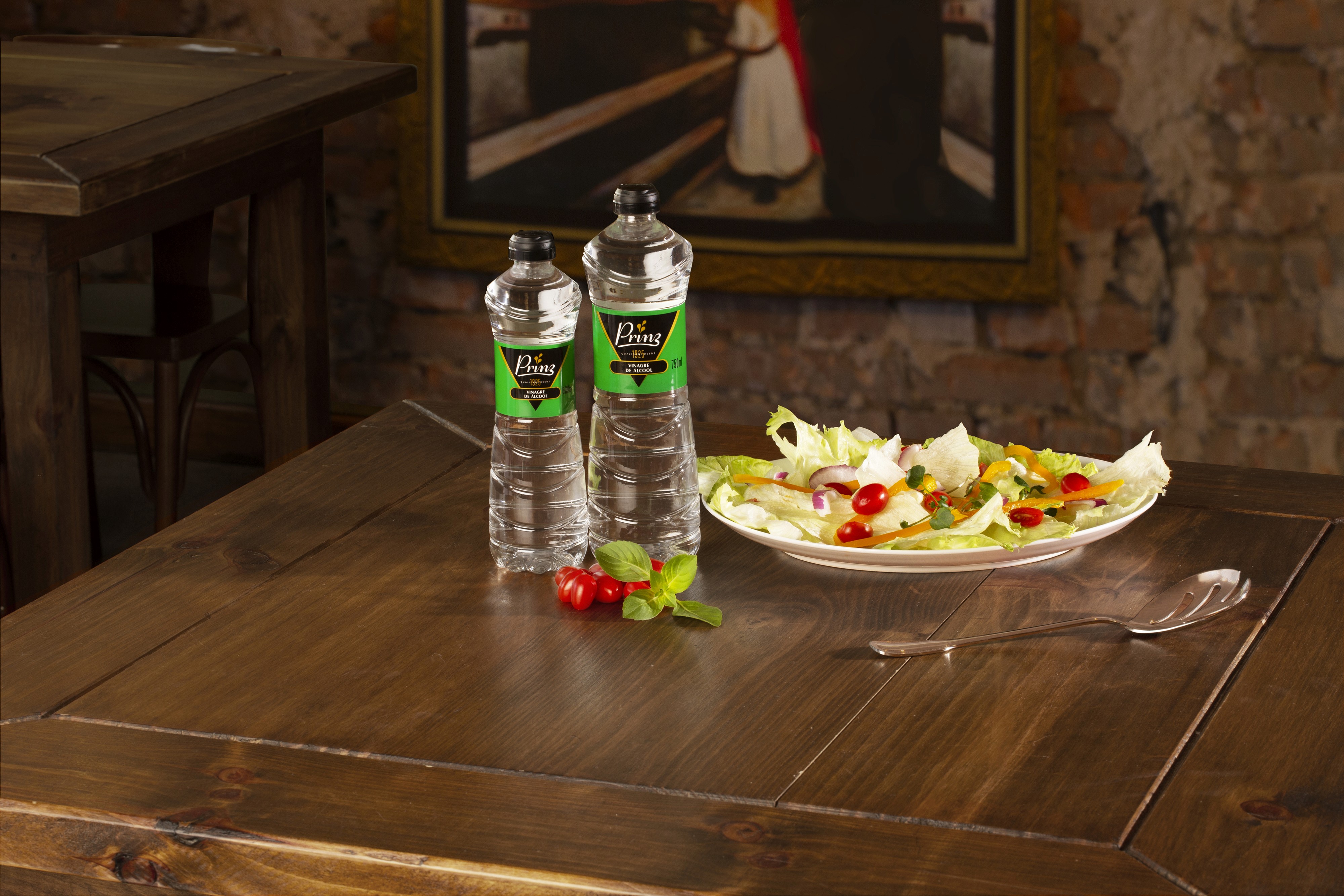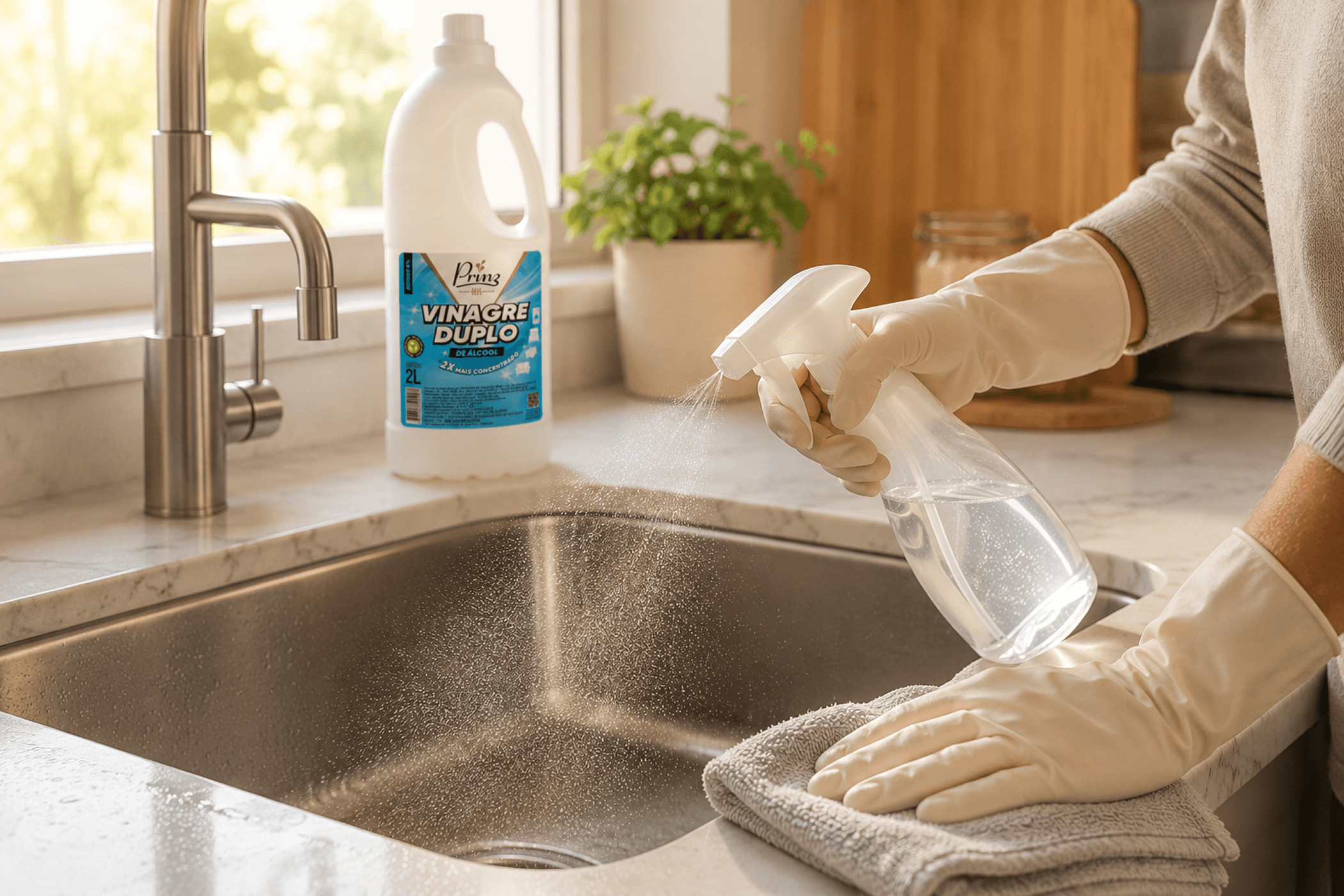
Alcohol Vinegar has ceased to occupy the simple space of a homemade alternative to assume a relevant technical role in domestic and professional cleaning. Its application goes beyond the occasional replacement of conventional products: it is an input with a simple, but highly efficient chemical base, capable of acting in different contexts, from the removal of mineral residues to the neutralization of odors and surface maintenance.
This movement accompanies a broader shift in consumer behavior and resource management. Residential environments and professional operations have started to prioritize more versatile, predictable solutions with a lower environmental impact, reducing dependency on multiple specialized products.
Thus, Alcohol Vinegar also gains prominence as a sustainable alternative when compared to conventional cleaners. Its simpler composition, absence of synthetic fragrances, and lower load of complex chemical compounds contribute to reducing the environmental impact throughout its use, in addition to decreasing the release of potentially irritating substances into the environment.
However, despite its apparent simplicity, the efficient use of Alcohol Vinegar requires technical understanding. Factors such as concentration, method of application, compatibility with materials, and frequency of use directly influence the results.
Throughout this content, you will understand how Alcohol Vinegar is produced, why it works so well in cleaning, and how to use it in a strategic, safe, and efficient way in your daily routine. Continue reading.
What is Alcohol Vinegar and how is it produced?
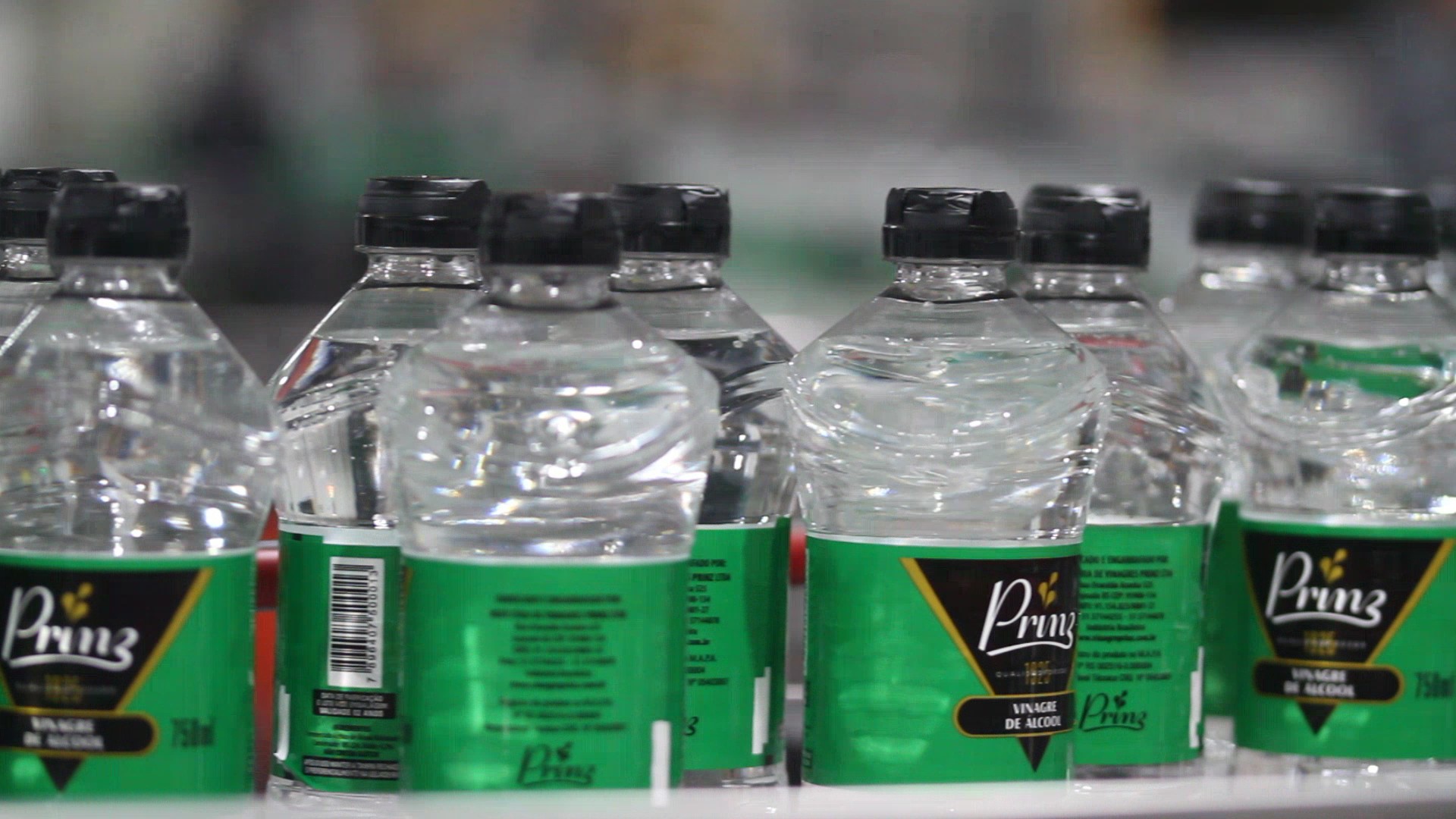
Alcohol Vinegar is an aqueous solution of acetic acid obtained from the fermentation of ethyl alcohol, generally derived from sugarcane in the Brazilian context. Unlike vinegars of more complex food origin, such as wine or apple cider vinegars, it is characterized by its purer and more controlled composition.
Its production process occurs in two fundamental stages:
Alcoholic fermentation (previous stage): the raw material rich in sugars is converted into alcohol by the action of yeasts;
Acetic fermentation: bacteria of the genus Acetobacter oxidize the alcohol, transforming it into acetic acid.
The result is a product with high standardization of acidity and low content of residual compounds. This characteristic is decisive for its use in cleaning.
Technical differential of Alcohol Vinegar
Unlike other types of vinegar, Alcohol Vinegar features:
Absence of natural pigments;
Absence of residual sugars;
Lower presence of complex organic compounds.
In general, this means that it:
Does not stain light-colored surfaces;
Does not leave sticky residues;
Evaporates without interfering with the final cleaning finish.
This predictability makes Alcohol Vinegar the most suitable standard for sanitization applications, especially in environments that require visual and functional control of cleaning.
Why is it widely used in cleaning?
The efficiency of Alcohol Vinegar in cleaning is directly related to acetic acid, which is responsible for its acidity and reactive capacity. With a pH between 2.5 and 3.0, it acts on different types of dirt through specific chemical reactions.
Its primary function lies in the dissolution of mineral residues, such as calcium and magnesium, common in shower screens, faucets, and surfaces exposed to water. This action allows the removal of stains and scale without the need for abrasives, preserving the materials.
It is worth remembering that vinegar also contributes to the breakdown of grease and organic matter, facilitating the removal of residues in kitchens and food preparation areas. Another differential is the neutralization of odors: it reacts with compounds responsible for the smell, reducing their presence in the environment.
In daily life, this translates into efficient applications in both domestic use (such as in cleaning surfaces and eliminating odors) and professional contexts, where it assists in the standardization of processes with predictability and less operational complexity.
Main applications in daily life
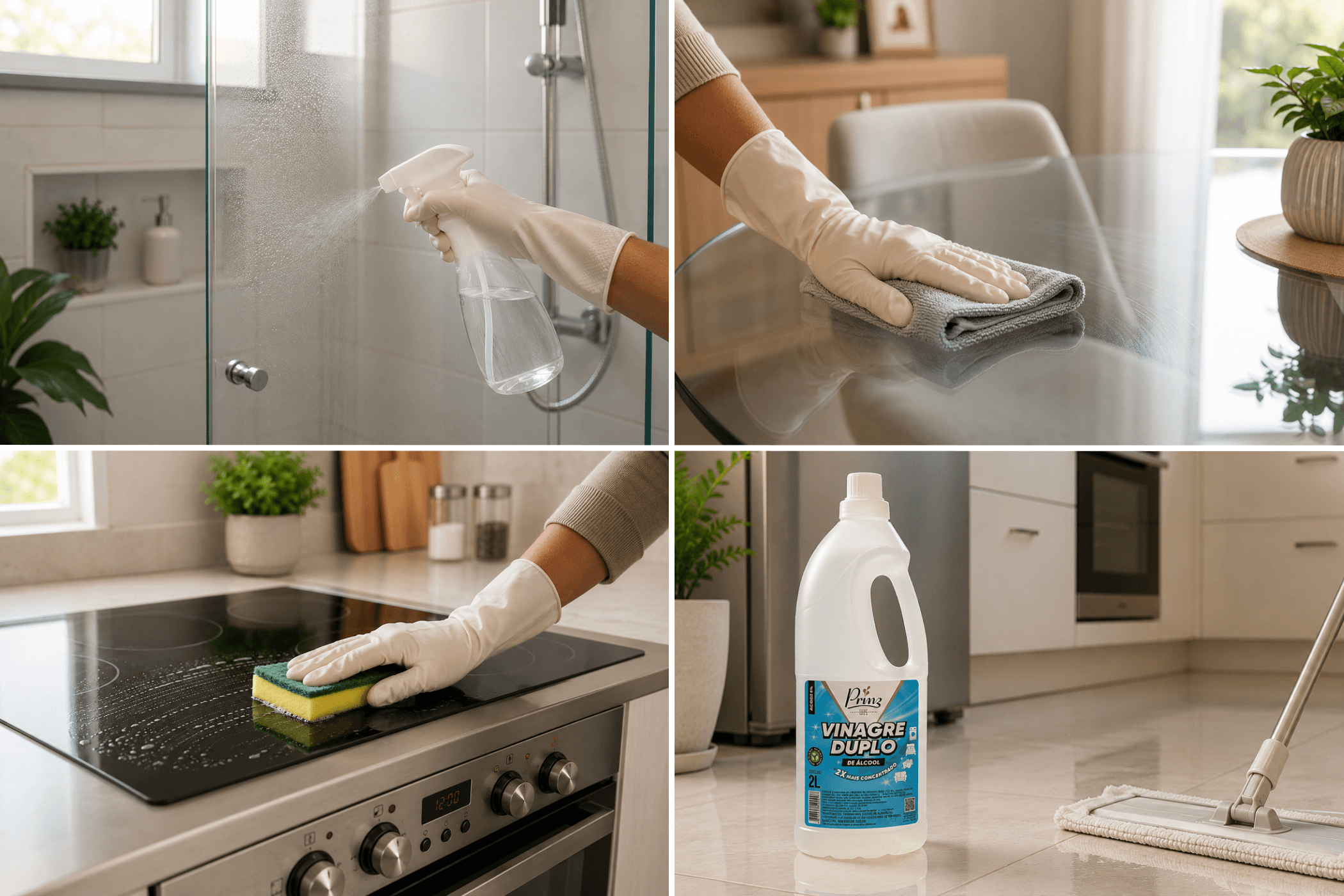
The popularization of Alcohol Vinegar for cleaning is frequently attributed to its versatility, which allows its application in different areas with consistent and effective performance when used correctly. See where and what to use it for:
→ Kitchen and food areas
Removal of grease on stoves, range hoods, and countertops;
Internal cleaning of microwaves and refrigerators;
Sanitization of surfaces without leaving chemical residues.
→ Bathrooms and washrooms
Removal of limescale stains on glass shower screens;
Cleaning of faucets, showers, and metal surfaces;
Reduction of grime and soap scum.
→ Glass and mirrored surfaces
Fast drying, preventing cloth marks;
Clean finish, without residues or film.
→ Laundry and fabric maintenance
Acting as a natural fabric softener by balancing the pH of the fibers;
Removal and neutralization of persistent odors (mold, sweat);
Assistance in preserving fabrics in frequent use.
This wide range of use reduces the need for multiple products, simplifying routines and processes.
How to correctly use Alcohol Vinegar: dilution, combinations, and restrictions
For Alcohol Vinegar to have real effectiveness in cleaning, it is necessary to pay attention to the composition, and especially to the way it is applied. Concentration, contact time, and compatibility with materials are factors that determine both performance and safety of use.
When used inappropriately, vinegar can lose effectiveness or even cause progressive damage to sensitive surfaces. On the other hand, when applied with technical criteria, it becomes a highly predictable resource, capable of delivering consistent results with less wear and tear on materials.
The table below organizes the main forms of use, safe combinations, and important restrictions to ensure an efficient and risk-free application:
Guide: using Alcohol Vinegar in cleaning
Usage Situation | How to Apply | Practical Indication | Technical Benefit | Important Care |
General cleaning (maintenance) | Dilute 50% vinegar + 50% water | Everyday surfaces, such as countertops, glass, and frequent contact areas | Reduces acidity without losing efficiency, preventing material wear | Ideal for recurring use and more sensitive surfaces |
Heavy cleaning (scale) | Apply undiluted directly to the surface | Shower screens, faucets, grouts with limescale | Increases reaction power on mineral deposits | Do not leave to act for long periods without rinsing |
Grease removal | Vinegar + a few drops of neutral detergent | Stoves, range hoods, and vertical surfaces | Detergent improves the breakdown and removal of grease | Avoid excess detergent to not generate residues |
Surface finishing | Apply with a microfiber cloth | Glass, mirrors, and smooth surfaces | Even distribution and drying without marks | Use a clean cloth to avoid scratches |
Odour neutralization | Apply diluted or undiluted depending on intensity | Refrigerators, fabrics, and enclosed areas | Reacts with compounds responsible for the odor | Ensure adequate ventilation after application |
Forbidden combination | Never mix with bleach or chlorine | — | Avoids release of toxic gases (chlorine gas) | High risk to respiratory health |
Natural stones | Do not use | Marble, granite, and calcareous surfaces | Avoids chemical corrosion and loss of shine | Damage can be irreversible |
Screens and electronics | Do not apply directly | TVs, monitors, sensitive screens | Preserves protective films | Use specific products |
Rubbers and seals | Avoid frequent use without rinsing | Washing machines, sealants | Avoids drying out and loss of elasticity | Always rinse after application |
Safety test | Apply to a discreet area before use | Any new or sensitive surface | Reduces risk of unexpected damage | Recommended practice in all cases |
Different solutions for different demands
Cleaning efficiency does not depend only on the method, but also on the quality and suitability of the resource used. In this context, Prinz Alcohol Vinegars stand out for offering standardization of acidity, consistency between batches, and different presentations that meet both domestic use and professional demands.
Among the highlights of the portfolio is the Double Alcohol Vinegar, with 8% acidity, a higher concentration that expands its performance capacity in more demanding cleanings; it is especially indicated for removing mineral scale, more intense degreasing, and applications that require higher performance with lower product volume.
On the other hand, the Traditional Alcohol Vinegar maintains the balance between efficiency and versatility, being ideal for recurring use in daily cleanings. Its formulation guarantees good performance on different surfaces, with a clean finish and no residue, meeting domestic routines with predictability and convenience.
Prinz also differentiates itself through a variety of presentations, allowing the product to be matched to the context of use:
Traditional Alcohol Vinegar in 750ml, 500ml, 3-liter jug, and 5-liter jug packaging;
Double Alcohol Vinegar (8% acidity) available in 750ml, 2-liter, and 5-liter jug packaging.
This diversity facilitates selection according to the intensity of cleaning, frequency of use, and scale of operation, ensuring efficiency with better product utilization.
Differences between Alcohol Vinegar and other types
The choice of vinegar type directly impacts the cleaning result, especially in terms of finish, material safety, and predictability of use. Although all contain acetic acid, the difference lies in the composition.
Alcohol Vinegar is colorless, contains no sugars, and has standardized acidity. This ensures a clean application, without stains or residues, plus consistent behavior on different surfaces.
Fruit or wine vinegars possess natural pigments and organic compounds, including residual sugars. In cleaning, these elements can leave a film, generate stains, and compromise the final result.
In general, this difference becomes evident in applications such as glass and mirrors, where any residue is visible, on light-colored surfaces, which may undergo color changes, and in the laundry, where sugars can interfere with fibers and fabric odors. In professional environments, this variation also impacts the standardization of processes.
Therefore, when the objective is cleaning, Alcohol Vinegar solidifies as the safest and most predictable option.
→ The smell myth
But what about the salad smell? This is the number one question from those starting to use vinegar for cleaning. Let us debunk this now:
The characteristic odor of acetic acid is volatile. This means it 'travels' through the air and does not bind to surfaces. Unlike synthetic perfumes that stick to fibers and materials, the smell of Alcohol Vinegar disappears 100% as soon as the surface dries.
Expert tip: If you are cleaning a very enclosed environment, maintain ventilation for 5 minutes. After drying, what remains is only the sensation of neutral cleanliness and the total absence of unwanted odors (since vinegar neutralizes smelly molecules instead of just masking them).
Advantages, cost-benefit, and precautions when using Alcohol Vinegar
The adoption of Alcohol Vinegar as a cleaning agent goes beyond simple product replacement. It is a smart choice that combines chemical efficiency, operational simplification, and greater control over results over time.
More Savings
From an economic standpoint, its main differentiator lies in cost reduction. A single product can replace different categories of cleaners, such as degreasers, glass cleaners, and even fabric softeners, reducing the complexity of purchasing, storage, and replenishment. This rationalization directly impacts resource management in both domestic use and professional operations.
Versatility
Alcohol Vinegar acts consistently across multiple environments, adapting to different types of dirt when used with the correct dilution. This allows for cleaning routines to be organized with less reliance on specific products.
Sustainability
From an environmental perspective, it stands out as a more sustainable alternative. Its simpler, biodegradable composition reduces the burden of chemical substances discharged into the environment, in addition to decreasing packaging consumption by replacing multiple products. This feature also contributes to practices aligned with ESG criteria, especially in operations seeking to reduce environmental impact.
Health
There is also a gain in occupational health. By not containing intense synthetic fragrances or aggressive compounds common in conventional cleaners, Alcohol Vinegar reduces exposure to irritating fumes, especially in enclosed or continuously used environments.
However, its efficient use depends on some technical care. It is essential to carry out preliminary tests on sensitive surfaces, avoid prolonged exposure to metals to not accelerate oxidation processes, and rinse when necessary to stop the acidic action after cleaning. It is also important to adjust the frequency of use according to the material, preventing cumulative wear.
When properly applied, Alcohol Vinegar offers a consistent balance between efficiency, safety, and durability, allowing for a more logical, predictable, and sustainable cleaning in the long term.
The future of cleaning is simple, efficient, and sustainable
Alcohol Vinegar is established as one of the most efficient and versatile products within a smarter cleaning logic. Its effectiveness comes from the action of acetic acid and the combination of chemical performance, predictability of results, and adaptability to different usage contexts.
Unlike fragmented solutions that require multiple products for each type of application, Alcohol Vinegar simplifies processes without sacrificing efficiency. It reduces routine complexity, optimizes costs, and contributes to a more rational management of resources.
This positioning becomes even more relevant in a scenario where sustainability, chemical control, and occupational safety are decision criteria. When used strategically, Alcohol Vinegar is more than a cleaning agent: it organizes, standardizes, and qualifies how cleaning is conducted.
But efficiency, in this case, is not just in the product; it is in its use. Understanding how to apply it, where to use it, and what limitations to respect is what transforms a simple resource into a high-performance solution capable of delivering consistency in the short term and preserving surfaces in the long term.
If the proposal is to evolve the way you clean, with more control, less waste, and better results, the next step is to choose a product that delivers this predictability.