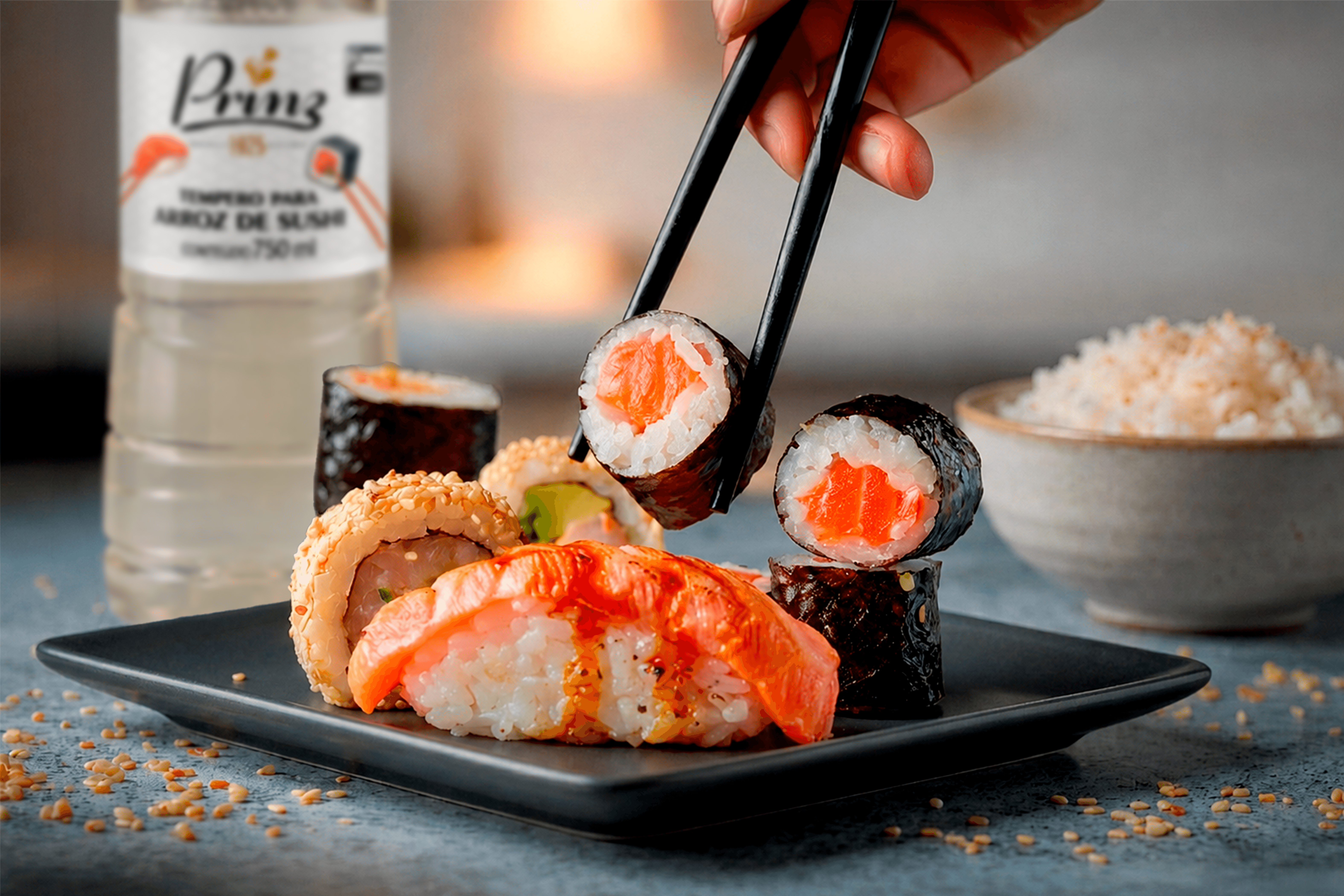
There is a common perception that sushi relies mainly on the quality of the fish. Although the freshness of the ingredients is indeed decisive, in Japanese tradition there is a different understanding: rice is the true center of the experience.
In Japanese cuisine, seasoned rice is responsible for texture, temperature, moisture, and integration between ingredients. A technically correct sushi relies on rice that has shine, controlled stickiness, softness, and seasoning capable of enhancing the ingredients without overpowering flavors.
It is precisely at this point that Sushi Rice Seasoning comes into play. It acts directly on creating the flavor, the stability of the rice, and even the tactile experience of each piece.
Understanding how this seasoning works is essential to preparing better sushi and understanding why Japanese cuisine treats rice as an element of extreme precision.
What is Sushi Rice Seasoning?
Sushi Rice Seasoning is a combination developed to transform cooked grain into what is called shari, the name given to the seasoned rice used in sushi. Traditionally, this mixture is made from rice vinegar, sugar, and salt. The balance between these three elements is what defines the identity of sushi.
Contrary to what many people imagine, the seasoning is not just to make the rice sweet and sour. Its function is much broader. It directly interferes with:
The grain texture;
The surface shine of the rice;
The correct stickiness between the grains;
The flavor perception of the fish;
The stability of the preparation;
Food preservation.
Without the correct seasoning, rice loses the characteristic that distinguishes sushi from simple molded white rice.
How acidity interferes with Shari
The acidity of the seasoning exerts a direct influence on the structure of the rice. This balance is delicate. Unsufficient seasoning can make the rice heavy and compact. Excess liquid, on the other hand, completely compromises the structure of the sushi, producing soggy rice that is difficult to shape and unbalanced.
At the same time, this acidity needs to remain controlled. Technically correct sushi should not transmit alcoholic aggressiveness or an excessively vinegary sensation. The goal is to create lightness and freshness.
Ideal temperature, texture, and stickiness
The correct texture of sushi rice relies on an extremely precise balance. The rice should not be cold, because very low temperatures harden the grains and reduce aromatic perception. It should also not be excessively hot, since heat alters the sensory perception of the fish's flavor or texture and compromises the tactile experience of the piece.
Stickiness also needs to remain balanced. The rice must keep the piece structured during handling but release easily in the mouth. When compacted too much, the sushi loses lightness and becomes heavy. When there is insufficient stickiness, the piece falls apart even before consumption.
This precision is one of the reasons why rice preparation is considered technically complex in Japanese cuisine.
What is the difference between rice vinegar and sushi seasoning
Although many people use the terms synonymously, Rice Vinegar and Sushi Seasoning have different functions within the preparation of sushi.
Rice Vinegar is the base ingredient responsible for the characteristic mild acidity of Shari. Produced from the fermentation of rice, it has a more delicate and less aggressive profile compared to other types of vinegar.
On the other hand, Sushi Seasoning is a ready-made formulation developed specifically for the preparation of Japanese rice, engineered to deliver a balance of flavor, stability, and standardization in the final result.
Objectively, this means that pure Rice Vinegar still needs to go through adjustments until it reaches the traditional profile used in sushi.
Ready-made seasoning reduces preparation steps and contributes to:
Greater standardization;
Stability between preparations;
Operational practicality;
Reduction of waste;
Flavor consistency.
Ready-to-use solutions are excellent alternatives for restaurants, delivery operations, supermarkets, and professional kitchens that need to maintain regularity in Shari preparation.

What makes up sushi rice seasoning
Sushi Rice Seasoning is developed from the balance between acidity, sweetness, and salinity. Its composition usually combines Rice Vinegar, Alcohol Vinegar, sugar, salt, and, in some formulations, complementary ingredients responsible for expanding the sensory complexity of the preparation.
Rice Vinegar directly participates in building the characteristic mild acidity of sushi, besides influencing the aromatic profile and the surface structure of the rice. On the other hand, Alcohol Vinegar contributes to the stability, balance of the formulation, and definition of the acidity present in the seasoning.
Sugar acts in softening the acidity and contributes to shine, a light sweetness, and the sensory rounding of the rice; salt enhances flavors and helps build greater gustatory depth in the preparation.
The combination of these components allows for the creation of a balanced profile, designed to bring the final result closer to the characteristics traditionally associated with the rice used in Japanese cuisine.
What is the best rice for sushi?
The rice used in sushi plays a central role in the texture, stickiness, and stability of the Shari. Therefore, choosing the correct type of grain makes a direct difference in the final result.
Traditionally, short or medium-grain Japanese rice is used, known for having a higher concentration of starch and capacity for stickiness. These characteristics help the rice maintain a uniform shape without losing lightness, allowing for proper molding of the pieces.
Unlike drier and looser rices, like long-grain or parboiled, rice designed for sushi develops a moister and more cohesive texture after cooking, favoring the incorporation of the seasoning and the integration between the grains.
Another important point is absorption. Japanese rice manages to incorporate the seasoning better without losing structure, preserving shine, softness, and stability during preparation.
Although there are domestic adaptations using other types of rice, more technical preparations usually prioritize specific varieties for sushi precisely because of the greater predictability in the final result.
Among the most important characteristics in a sushi rice are:
Good capacity for stickiness;
Uniform cooking;
Balanced absorption of the seasoning;
Soft texture without excess moisture;
Capacity for molding without excessive compaction.
The correct rice does not act solely as the base of the sushi. It directly influences the perception of texture, temperature, and balance between all the ingredients of the piece.
How to make sushi rice correctly
The preparation of sushi rice requires attention at all stages, as small variations can completely alter the final result.
The first step is to wash the rice to remove excess surface starch and avoid an excessively sticky texture. After that, many preparations include a brief rest before cooking to favor a more uniform hydration of the grains.
The proportion between water and rice is also fundamental. Excess water leaves the rice soft and without structure, while too little water compromises cooking and stickiness.
After cooking, the rice must rest quickly before incorporating the seasoning, which needs to be added while still hot to ensure uniform absorption and better distribution of flavors.
The mixing must be done with light cutting movements, avoiding crushing the grains. During this process, the rice is also cooled gradually to help with the evaporation of excess moisture and the formation of Shari's characteristic shine.
Some mistakes commonly compromise the result completely:
Excess water;
Seasoning cold rice;
Using inadequate rice;
Overdoing the acidity;
Mixing the grains aggressively.
The final goal is to obtain light, shiny rice with enough stickiness to support the sushi without becoming compact or heavy.

Ready-made seasoning or manual preparation
The choice between artisanal preparation and ready-made seasoning depends mainly on the level of operational control required in the production of sushi. Although many traditional houses develop their own formulations, manual preparation requires constant precision and extremely rigorous control of the proportions used.
Small variations in sugar, salt, or vinegar are enough to alter important aspects of the rice. In professional operations, this can generate noticeable inconsistencies between different preparations, operators, or units.
In addition to the formulation itself, manual preparation also requires additional steps, such as:
Heating;
Complete dissolution of ingredients;
Temperature control;
Cooling;
Continuous standardization.
This process increases operational time, technical dependence on the team, and risk of waste.
Many food service operations, supermarkets, deliveries, and dark kitchens use ready-made seasonings to ensure greater stability and consistency between batches. The ready-made solution reduces production steps, facilitates team training, and helps maintain a more uniform standard in the final result.
Standardization is one of the main advantages. In higher volume operations, consistency is usually as important as flavor.
Criterion | Manual Preparation | Ready-to-use Seasoning |
Standardization | Varies by operator | High consistency |
Operational time | Higher | Reduced |
Acidity control | Unstable | Standardized |
Technical dependence | High | Lower |
Scalability | More limited | Facilitated |
Risk of error | Elevated | Reduced |
Sensory consistency | Fluctuates between preparations | More stable |
Waste | Larger | Smaller |
Team training | More complex | Simplified |
Control between units | Difficult | More uniform |
How to choose a seasoning for sushi rice
Choosing a good seasoning for sushi rice involves more than just looking at acidity or flavor intensity. A balanced seasoning should have a mild and clean acidity, without excessive alcoholic aggressiveness.
The sweetness needs to remain discreet, functioning as an element of balance and not as the predominant flavor. On the other side, salt should enhance the ingredients without compromising delicacy and freshness.
The very appearance of the product can also indicate stability and quality. Balanced formulations normally present a clear and homogeneous aspect.
Another important point is versatility. A good seasoning works not only in traditional sushi, but also in:
Poke;
Temakis;
Sunomono;
Asian salads;
Light marinades.
What is the ideal amount of seasoning in rice
The quantity used directly affects the final result. On average, between 100 ml and 150 ml of seasoning is used for each kilo of dry rice, although this proportion may vary depending on the style of the sushi, the desired sensory profile, and the type of operation.
More delicate preparations usually work with milder acidity. Delivery-oriented operations often adjust formulations to preserve the stability of the rice for longer.
Other applications of sushi rice seasoning
Besides sushi, the seasoning can also be applied in different preparations of Asian cuisine. Its combination of acidity, sweetness, and salinity works very well in cold bases, vegetables, fish, and light dishes that require balance without excess intensity.
Perfect sushi rice starts with the right seasoning
Rice is the element that supports the entire sushi experience. Because of this, the seasoning used in Shari should not be treated as a simple complement, but as an essential part of the technical structure of the sushi.
When correctly balanced, it helps create a more uniform, stable, and palate-pleasing rice, preserving the characteristic delicacy of Japanese cuisine.
Relying on a ready-made solution also means gaining practicality, consistency, and more control over the final result. Prinz Sushi Rice Seasoning was developed precisely to simplify preparation without giving up balance, stability, and standardization, helping professional operations and home cooking achieve a more harmonious and uniform rice.
Whether in restaurants, delivery, supermarkets, or preparing at home, using a balanced seasoning makes a difference not only in flavor but in the entire sushi experience.
Discover how to combine practicality, yield, and consistency in each preparation. Prinz Sushi Rice Seasoning is available in 750ml, 5L, and 20L jug packaging, serving everything from domestic preparations to larger-scale professional operations.