
In the condiment market, vinegar is still treated by many buyers as a simple item, almost automatic in the supply routine. This perception, however, ignores that this type of product has become increasingly elaborate and now occupies a prominent space on Brazilian tables.
For wholesale, retail, food industry, and food service, choosing a reliable vinegar supplier is not a superficial decision. The issue involves comparing acidity consistency, labeling clarity, logistical reliability, portfolio adequacy, and the manufacturer's capacity to sustain the same standard over time.
In other words, choosing well does not only involve the product itself, but the supplier's capacity to sustain quality, raw supply consistency, and operational predictability throughout the commercial relationship.
Why choosing a vinegar supplier requires technical criteria
In various consumer categories, the brand may work as a sign of positioning or preference. In the case of vinegar, it represents something more concrete: the quality of the production process.
Vinegar is the result of acetic fermentation. We are talking about a product whose stability depends on rigorous control in stages that affect composition, acidity, transparency, aroma, and performance in use. When this control fails, the effects quickly appear in the operation.
Acidity fluctuation can compromise standardized recipes and alter the product's behavior in preserves and sauces. The presence of undesired residues can affect flavor, appearance, and quality perception. Meanwhile, formulation or bottling inconsistencies can reduce retail trust and harm the repurchase experience.
Therefore, choosing a vinegar supplier requires observing the entire productive and logistical structure behind the operation. The analysis must consider standardization history, the manufacturer's technical mastery, stability between batches, and the ability to maintain this standard continuously.
Broad portfolio as an indicator of productive capacity
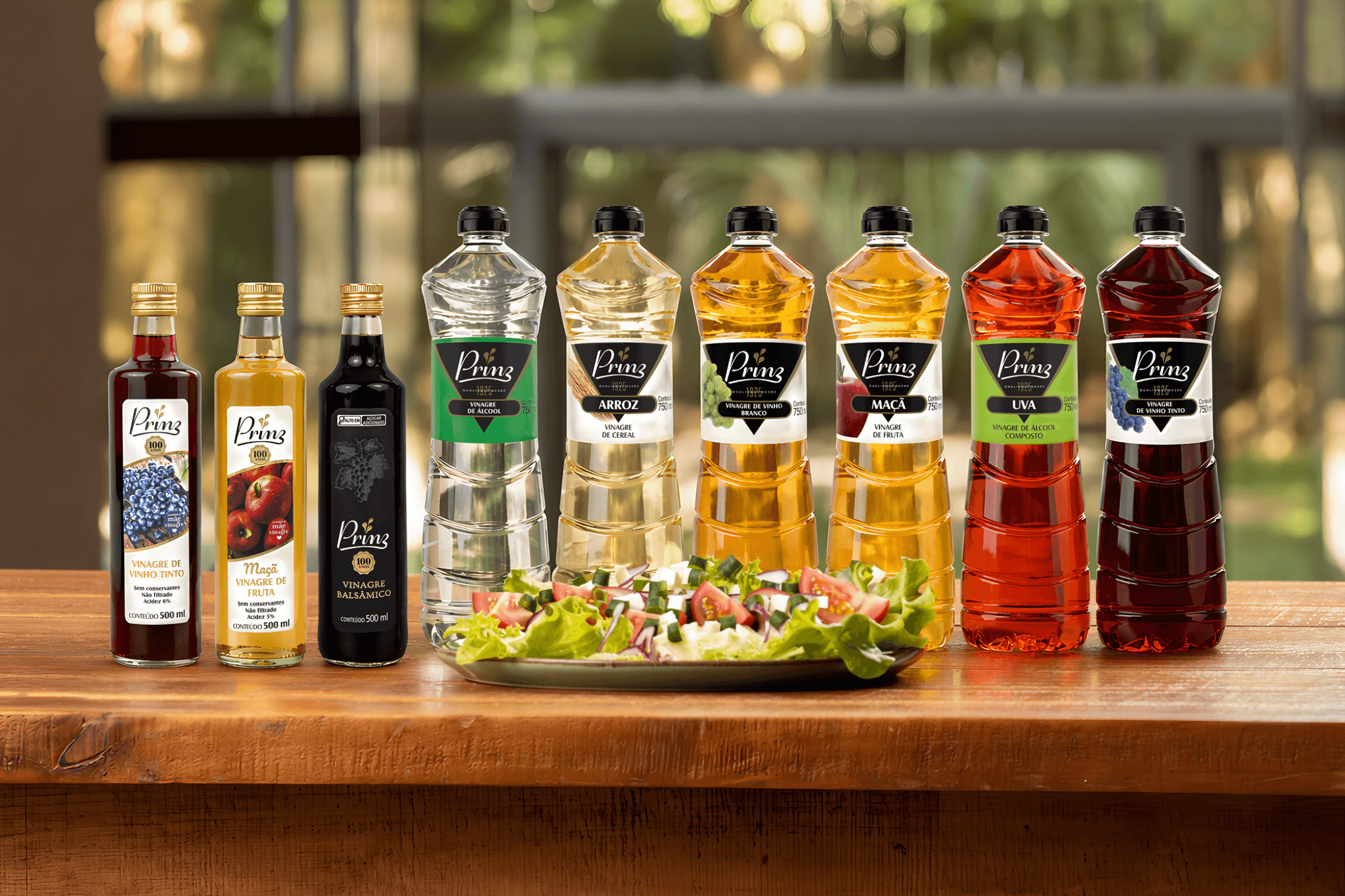
When evaluating a vinegar supplier, one of the first signs of technical maturity lies in the depth of the portfolio. Suppliers that operate only with more basic lines, typically concentrated on white alcohol vinegar and red wine vinegar, tend to act under a more restricted logic, focused especially on volume and price competitiveness. This does not invalidate their market presence, but it limits the reading on their specialization.
Manufacturers with a broader catalog usually demonstrate greater mastery of processes, raw materials, and applications. When a supplier works with distinct lines, they reveal the capacity to formulate, standardize, and position products for different needs.
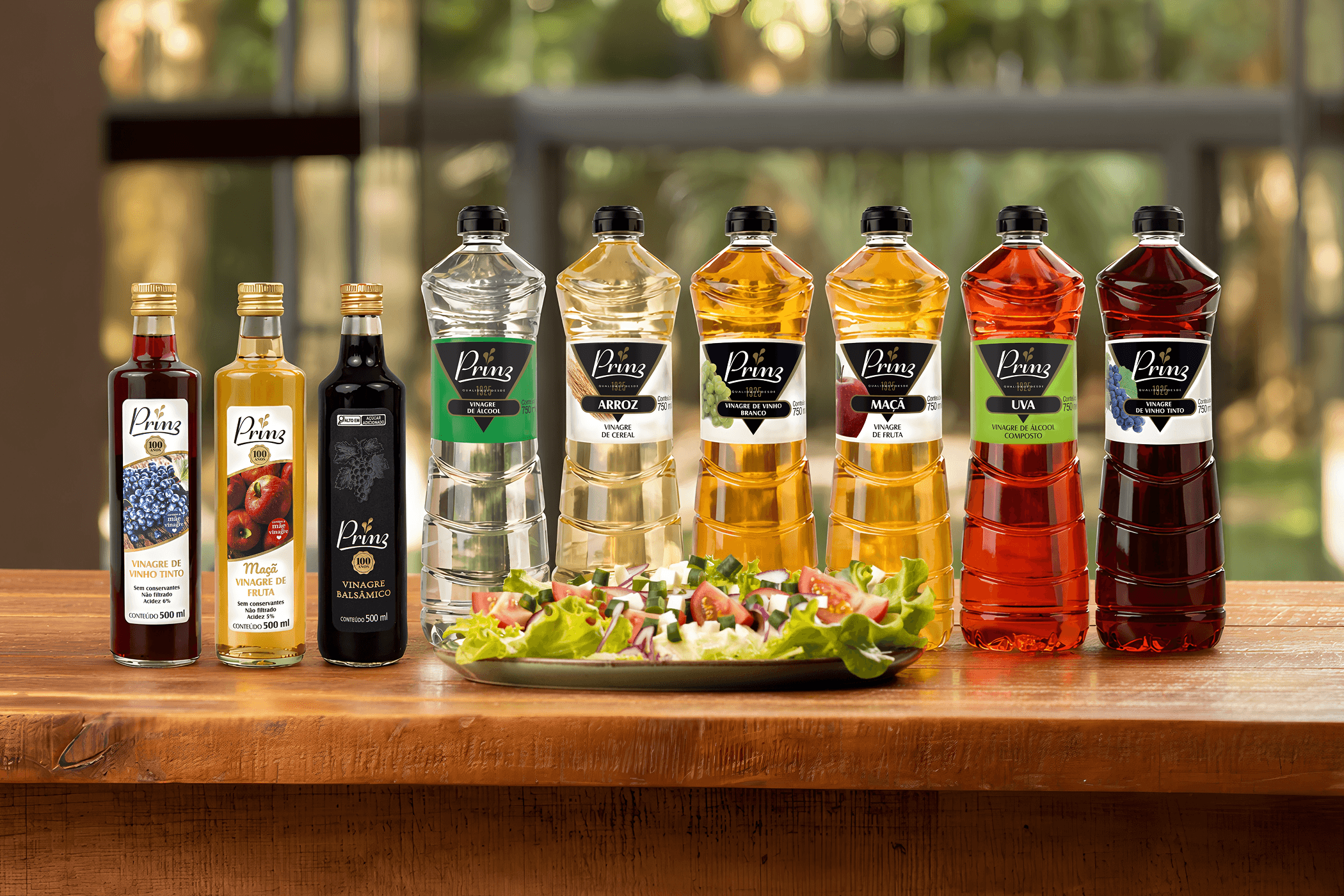
In Prinz's case, the breadth of the portfolio helps demonstrate the capacity to meet different market demands with standardization and productive stability. The portfolio covers fruit vinegars, flavored versions, organic and preservative-free, balsamic and special lines, in addition to traditional alcohol vinegars and options aimed at professional operations. This is a clear indicator of commercial diversity and productive knowledge applied to categories with distinct sensory and functional requirements.
This logic is important because suppliers who manage to work safely with products of greater complexity tend to transfer this same rigor to everyday high-turnover items. In short, this strengthens trust in the supplier as a supply partner.
Acidity and standardization: the core of the decision
For food service and the food industry, few factors are as important as acidity stability.
In common commercial applications, the market usually works with clear acidity references, and any variation outside the expected can generate a direct impact on the final result. Within a professional kitchen, this translates to changes in flavor and preparation balance. In industrial processes, it can affect preservation, yield, and formulation predictability.
Therefore, structured suppliers invest in physical-chemical control, laboratory monitoring, and batch repeatability to guarantee supply stability and technical predictability. The goal is to meet a minimum parameter and ensure that the product delivered today maintains the same behavior tomorrow, in the next shipment, and throughout the entire commercial relationship.
When this constancy exists, the buyer reduces operational risk. When it fails, the product stops being a solution and becomes a variable.
When choosing a vinegar supplier, standardization should not be treated as a secondary technical detail. It is, in fact, what separates a reliable supplier from a manufacturer whose delivery depends too much on process fluctuations.
How the vinegar supplier impacts household and professional operations
The choice of a vinegar supplier only makes sense when the context of use is clear. Applying the same criteria for household consumption and professional operations is a common mistake, which can lead to inadequate choices and considerably impact performance, cost, and quality perception.
Even in wholesale and retail operations, it is essential to evaluate how the product will be perceived by the final consumer, because there is no point in offering it on the shelf if the final consumer is not considered. Understanding these differences is the first step toward a more assertive decision.
Comparison between household and professional use
Criterion | Household use | Professional use |
Main goal | Daily consumption, practicality | Standardization, yield, and predictability |
Packaging | Small volumes (500ml–750ml), focus on ergonomics | Larger volumes (5L, 20L), focus on strength, stacking, and logistics |
Cost | Evaluated per unit | Evaluated by operational cost and yield per application |
Acidity control | Can vary without significant impact | Must be strictly stable to guarantee recipe and process standards |
Sensory profile | Milder and adapted to the general palate | Defined and consistent to avoid altering flavor between batches |
Impact of variation | Low perceived impact in daily life | High impact on recipes, preservation, and standardization |
Logistics and supply | Occasional retail purchase | Continuous, predictable supply with supplier support |
Choosing a vinegar supplier is a technical and operational decision. The raw material influences the sensory profile of the product, while acidity stability supports standardization, yield, and predictability of use. In professional operations, factors such as supply regularity, logistical capacity, and consistency between batches stop being differentiators and become structural demands.
How to choose a vinegar supplier with more security
Analyzing a vinegar supplier requires looking at a set of technical, production, and logistical factors that, together, reveal the manufacturer's real consistency.
→ Transparency of ingredients and processes
Reliable suppliers make clear what they deliver. This includes selected raw materials, adhering to strict quality criteria, product type, degree of standardization, and the presence or absence of components that influence raw quality perception. Clarity in labeling works as an indicator of seriousness and helps the buyer understand exactly what they are purchasing.
→ Packaging design and functionality
Packaging serves different functions depending on the channel. In retail, it contributes to exposure and turnover. In wholesale and food service, it must withstand handling, transport, and storage without generating losses. Lines with glass bottles, PET thickness, ergonomics, resistance, and the efficiency of the dosing cap are elements that directly influence the operation.
→ Market positioning
Not every supplier operates with the same market positioning. There are suppliers oriented toward price competitiveness, some focused on added value, and others that seek a balance between scale, quality, and portfolio. Understanding this positioning helps to better choose the product mix and avoid expectation mismatches regarding margin, audience, and quality perception.
→ Support and logistical capacity
For restaurants and resellers, a good supplier is not just one who delivers a technically correct product. It is one who sustains this supply regularly, with adequate coverage and an efficient response in situations of damage, replacement, or increased demand. In many cases, this factor weighs as much as the quality of the vinegar itself.

What to evaluate in the logistics and supply of a vinegar supplier
In retail, food service, and food industry operations, product quality must walk hand-in-hand with supply capacity. A technically consistent supplier, but one unable to sustain regular deliveries, can cause operational impacts just as critical as standardization issues.
Therefore, logistics and distribution must be part of the analysis from the very beginning of the negotiation.
Delivery regularity directly influences inventory control, purchasing predictability, and operational continuity. Recurrent delays, low responsiveness, or replacement difficulties can compromise everything from shelf stocking to industrial assembly lines and professional kitchens.
Another important point is the supplier's logistical structure. Companies with their own distribution operations, consolidated regional coverage, and scalability tend to offer greater stability in scenarios of increased demand, seasonality, or commercial expansion.
It is also important to evaluate factors such as:
Supply frequency;
In-service capacity in different regions;
Lead time predictability;
Support in cases of damage or stockouts;
Supply stability between batches;
Capacity to adapt to the growth of the operation.
Suppliers with a structured logistical operation tend to offer greater commercial predictability and security. Prinz, for example, has its own distribution fleet, which contributes to greater delivery control, supply regularity, and service capacity for different regions and operational profiles.

How to choose the ideal vinegar supplier for each operation
The choice of a good vinegar supplier should start from practical application. More important than searching for a 'better' supplier, it is essential to understand which one meets the demands of the final use most precisely, considering volume, standardization, and expected results.
→ For preserves and the food industry
Here, the priority is stability. Acidity must be strictly controlled, as any variation directly impacts shelf life and product safety.
Example: a preserving industry that uses vinegar with acidity variation can compromise the shelf life of the final product, generating losses and health risks.
→ For retail (supermarkets)
In this case, the strategy involves mix composition. It is important to balance fast-moving products with higher-value-added options, which increase margins and elevate the category's perception.
Example: a supermarket can work with high-volume suppliers to meet basic consumption and include a more specialized brand to expand the average ticket and differentiation.
→ For gastronomy (restaurants)
In the professional kitchen, vinegar must have a clear sensory identity and consistency between batches. This ensures predictability in flavor and avoids constant adjustments in recipes.
Example: a restaurant that uses balsamic vinegar for finishing plates needs to ensure that the flavor and density remain stable so as not to compromise the dining experience.
What to evaluate in a national or international vinegar supplier
When looking for a vinegar supplier, it is common to associate quality only with price or origin. However, supply operations require a much broader analysis, involving productive capacity, logistical regularity, standardization, and supply stability.
National scenario
The national vinegar market gathers suppliers with different productive structures, logistical capacities, and commercial positionings, in addition to manufacturers operating in different regions and segments of the food sector.
Within this scenario, there are companies with a long productive tradition and broad portfolios, capable of serving multiple consumption contexts. Others direct their actions to specific niches or certain applications, while some operate with a focus on competitiveness, scale, and a wide retail presence.
This diversity of positioning demonstrates that the vinegar market is not organized based on a single criterion. Aspects such as production history, standardization, variety of lines, distribution capacity, and value proposition directly influence how each brand positions itself in the sector.
International scenario
In the international context, the vinegar market is marked by companies with a long production tradition and strong productive and commercial consolidation. Many represent industrial models that combine historical heritage, technical control, and global presence.
These companies operate with a high level of standardization and process control, ensuring consistency between processes and performance predictability, while preserving features associated with their tradition of origin. In many cases, they manage to operate both in the gastronomic and large-scale segments, serving different markets with well-structured portfolios.
The relevance of each lies in the ability to balance tradition and productive efficiency, consolidating standards that influence the sector on a global scale.
Why Prinz stands out
Throughout the search for a vinegar supplier, it becomes clear that truly relevant criteria go far beyond price or market visibility. What sustains a consistent choice is the combination of a reliable process, a portfolio compatible with different uses, and the ability to serve the operation without generating uncertainty.
In this perspective, Prinz consolidates itself as a brand structured to meet these requirements. Its performance combines productive tradition, breadth of product lines, and supply capacity, serving both daily consumption and the most demanding operational needs.
This set of factors directly impacts supply predictability, usage stability, and operational efficiency, which are decisive aspects for those who need to choose a vinegar supplier with a more technical and strategic view.
Choosing well begins with understanding who sustains quality
Choosing a vinegar supplier with criteria is a way to protect margins, preserve delivery standards, and build a more stable operation. When the analysis includes acidity, portfolio, adequacy of use, and logistical reliability, the decision stops being purely commercial and becomes structural.
If your company is looking for a vinegar supplier capable of combining technical consistency, portfolio variety, supply stability, and structured logistical support, it is worth looking deeply into who actually sustains these factors day-to-day.
Speak with a Prinz specialist and evaluate the most suitable solution for your operation.
FAQ: What to evaluate before signing with a vinegar supplier
What should be considered when choosing a vinegar supplier for the food industry?
The food industry must evaluate strict acidity control, batch repeatability, supply stability, and the supplier's capacity to meet continuous demands without compromising standardization and safety.
How to choose a vinegar supplier for food service?
In food service, it is important to prioritize suppliers capable of ensuring consistency between batches, delivery regularity, and sensory stability, avoiding alterations in the flavor and performance of preparations.
How do I know if a vinegar supplier is reliable?
A reliable supplier maintains acidity stability, standardization between batches, supply regularity, and logistical capacity compatible with the operation's demand. Label transparency and productive consistency are also important factors.
What should be analyzed before choosing a vinegar supplier?
It is important to evaluate the productive structure, quality control, portfolio variety, delivery predictability, distribution capacity, and suitability of the product for the type of operation served.
Why is standardization important in the supply of vinegar?
Standardization ensures flavor stability, yield, and performance in industrial applications, preserves, food service, and retail. Fluctuations in acidity can compromise recipes, preservation, and operational predictability.
How does logistics influence the choice of a vinegar supplier?
Logistics directly impacts supply regularity, inventory control, and operational continuity. Suppliers with a consolidated logistical structure tend to offer greater delivery predictability and lower risk of stockouts.
What is the difference between choosing a brand and choosing a vinegar supplier?
The choice of brand is typically associated with the perception of the product. Choosing a supplier, however, involves broader factors, such as productive capacity, supply stability, operational support, and logistical efficiency.
Does the vinegar supplier influence operational cost?
Yes. A supplier with good standardization and predictable supply helps reduce waste, avoid stockouts, and maintain greater operational stability, factors that directly impact operational costs.